


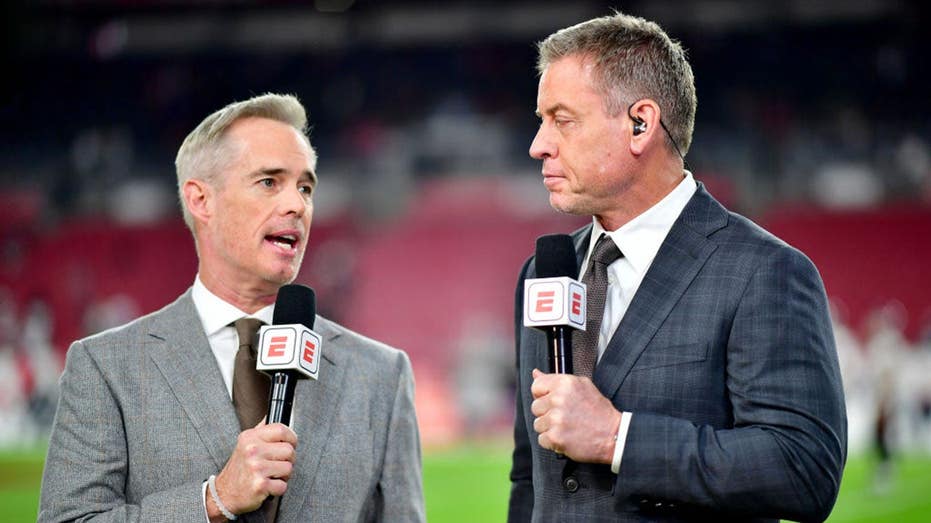
It is almost certainly over for Troy Aikman and Joe Buck as ESPN’s lead NFL broadcast team.
Reports that the ongoing drama is part of a leverage strategy now appear increasingly implausible. No one with knowledge of the situation expects Aikman to remain with ESPN beyond the end of this season.
In fact, there is more industry discussion about whether Aikman and Buck can work together through ESPN’s Super Bowl broadcast in February than about whether Aikman will re-sign with the network.
According to sources in and around ESPN, the prevailing expectation is that Aikman will leave, and the network will sign Greg Olsen to replace him in March.
Several outlets have reported on a confrontation between Buck and Aikman earlier this month before a Monday Night Football match up. Buck reportedly confronted Aikman for ignoring him, while Aikman accused Buck of sabotaging his contract negotiations by signing his own deal first.
BOBBY BURACK: ONLINE HATE IS WINNING, FROM PAT MCAFEE TO EVERYDAY AMERICANS AND YOUNG CHILDREN
Although the confrontation generated attention, it did not drive ESPN’s decision. The network decided this summer to move on from Aikman after re-signing Buck to a six-year, $108 million extension without offering Aikman a new contract.
It remains somewhat unclear why ESPN chose not to negotiate with Aikman, beyond his growing tensions with Buck in recent years. The best explanation is that ESPN viewed their relationship as irreparable and Buck as the more valuable asset.
If forced to choose, ESPN’s preference for Buck over Aikman is understandable.
For one, Buck and ESPN chairman Jimmy Pitaro share an interest in ESPN potentially acquiring the World Series after the 2029 season. If ESPN secures the event, sources say Pitaro wants Buck to call it, as he did for years at Fox.
ESPN also has more options to replace Aikman than it would have to replace Buck. The pool of potential replacements for the color analyst role extends beyond Olsen. In theory, Drew Brees, Jason Kelce, Eli Manning, Peyton Manning, Kurt Warner and Dan Orlovsky are also suitable options.
ZERO BS. JUST DAKICH. TAKE THE DON’T @ ME PODCAST ON THE ROAD. DOWNLOAD NOW!
Further, Hall of Fame players and coaches retire every year, and many show interest in broadcasting. Several networks have already expressed interest in Sean McVay and Matthew Stafford if they eventually move into television.
No such farm system exists for elite play-by-play announcers. On paper, the gap between Buck and the rest of the field remains significant. Granted, Dave Pasch, who calls college football and NBA games, has impressed on ESPN’s NFL International broadcasts this season.
So, we understand why ESPN would choose Buck over Aikman. The point of contention is that the network could mend the fences and retain them both.
Even 25 years later, Buck and Aikman are still often recognized as the best duo in sports broadcasting. Whether Buck and Olsen, assuming Olsen is the replacement, can develop comparable chemistry is a question mark.
After years of disappointing rotations, ESPN finally established a top-level booth in Buck and Aikman. Breaking them up feels like an unnecessary risk.
We understand that relationships are difficult, especially work relationships that span more than two decades. But at $18 million to $20 million per year each, ESPN should have been able to make the partnership work if it believed they were still the best duo for the position.
On air, it is hard to argue that they are not.


