


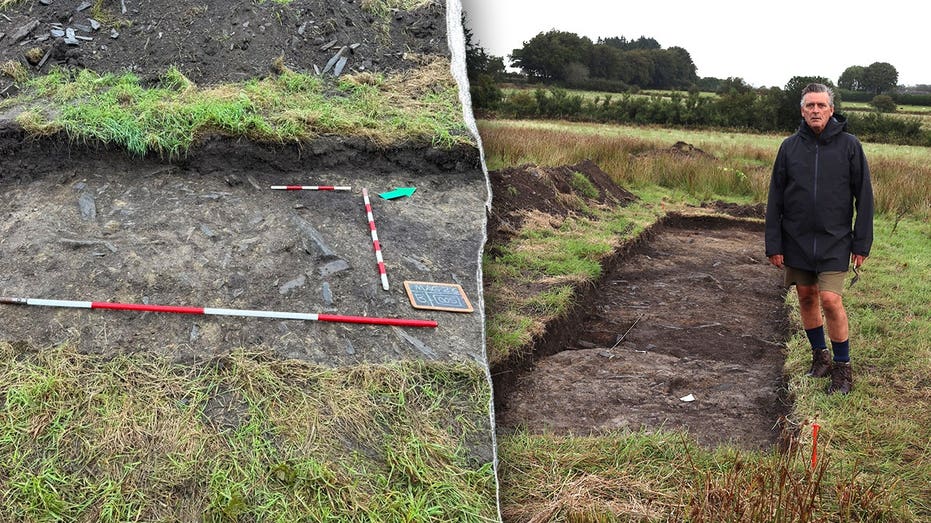
An ancient Roman fort discovered in a remote part of Wales could help unravel a centuries-old legend about a Roman emperor — and may have accommodated as many as 1,000 soldiers, the archaeologist behind the discovery told Fox News Digital.
The fort, located near Frenni Fawr in Pembrokeshire, was the subject of an October announcement by Wolfson College, Oxford, following recent excavations at the site.
Mark Merrony, a fellow at Wolfson College, Oxford, and editor-in-chief of Antiqvvs, an archaeology magazine, first identified the fort using satellite imagery in 2024.
AMERICA’S LITTLE-KNOWN CASTLES, DISPLAYING ‘RAW POWER,’ ARE HIDING IN PLAIN SIGHT
More recent excavations uncovered two Roman coins from the late fourth century, suggesting activity at the site may have continued into the period when Emperor Magnus Maximus ruled Britain from 383 to 388 A.D.
Merrony, who described the fort’s location as being in the “middle of nowhere,” told Fox News Digital the site could have accommodated significantly more soldiers than he initially estimated.
“I’ve been saying 500 troops, but actually it’s bigger than the housesteads on Hadrian’s Wall, which held 1,000 troops,” he said.
“So it could have held up to 1,000 auxiliary Roman soldiers.”
ARCHAEOLOGISTS UNCOVER MASSIVE ANCIENT SITE DURING RAIL PROJECT, INCLUDING RARE ROMAN FIND
Excavations also uncovered numerous Roman artifacts, including ceramic roofing tiles and what Merrony believes could be floor tiles or materials used for underfloor heating.
Despite the attention surrounding the fourth-century coins, Merrony believes the fort itself is more significant.
“I think the presence of the site is more important than the coins because it was almost certainly founded in the 1st century,” he said.
The possible connection to Maximus stems from the “Mabinogion,” a medieval collection of Welsh tales and legends that also features King Arthur.
HIDDEN UNDERGROUND CHAMBER REVEALED BENEATH HOME OF LEGENDARY ROMAN EMPEROR
One story recounts the Roman emperor establishing a military camp near Frenni Fawr.
Merrony told Fox News Digital he identified the fort while tracing the Roman road network, rather than deliberately searching for evidence of the legend.
After discovering the fort roughly two miles from the hill’s summit, he found no other known Roman sites nearby — leading him to suspect the fort could be the one described in the “Mabinogion.”
“And I put two and two together, and I thought the question is not whether this is the site. The question is, is the ‘Mabinogion’ correct? And I suspect it is,” Merrony said.
CLICK HERE TO SIGN UP FOR OUR LIFESTYLE NEWSLETTER
He cited the story’s “very strong historical underpinning,” suggesting that Roman soldiers may have traveled through the area during the late Roman period, possibly under Magnus Maximus himself.
Though the discovery does not establish that the emperor visited the fort, Merrony believes the legend may preserve the memory of an actual historical event.
He said he wasn’t surprised that the medieval tale might contain elements of historical truth.
CLICK HERE FOR MORE LIFESTYLE NEWS
“I think it’s often the case with mythology that it’s based on something,” Merrony told Fox News Digital, adding that it likely spread through oral tradition before being written down.
Merrony also theorized that Maximus may have visited the region in response to incursions by Irish groups during the fourth century, before departing Britain for continental Europe.
TEST YOURSELF WITH OUR LATEST LIFESTYLE QUIZ
Merrony, whose upcoming book, “Lives of the Roman Emperors: From Augustus to Romulus Augustulus,” explores the history of Rome’s emperors, also pointed to a possible Roman road running alongside the fort.
He believes the road could be part of a previously unidentified major route through Wales, although further archaeological investigation is needed.
Merrony also said an aqueduct feeding the fort remains to be investigated, with additional excavations planned for 2027.
Looking ahead, Merrony said his team plans to widen two excavation trenches over two buildings at the site. In one trench, researchers spotted what appeared to be a collapsed building.
“It had come over from the south and toppled north into parallel with the trench we were digging. So that heaven knows what’s under that. It’s going to be really exciting,” he said.


