


The Atlanta Dream and Golden State Valkyries left the court for the national anthem before the first two games of the WNBA Finals. Now Riley Gaines is arguing that those decisions should carry consequences when athletes seek to represent the United States internationally.
Gaines initially weighed in while sharing OutKick’s video of the Game 2 anthem absence.
“It’s my personal opinion that if you kneel for the flag and what it represents, you shouldn’t be able to represent the USA at the Olympics,” Gaines wrote on X.
DREAM, VALKYRIES SKIP NATIONAL ANTHEM IN WNBA FINALS GAME 2 DESPITE RULEBOOK REQUIREMENT
In a statement to OutKick, Gaines expanded her argument to players who leave the court to avoid the anthem.
“The American flag and our national anthem do not represent whichever political party or administration happens to be in power. They represent the American people, our shared identity, the freedoms we enjoy, and the generations of men and women who fought, sacrificed and died to preserve those freedoms,” Gaines said.
“Players who leave the court specifically to avoid the national anthem are making a deliberate statement. They are free to do so, of course. Free speech includes the freedom to withhold respect.”
“But I’m of the mind that choice has consequences when the same athletes later seek the honor of representing the United States on the international stage.”
Neither Finals team nor the WNBA has answered OutKick’s questions about the anthem absences. Nor has the NBA, whose commissioner, Adam Silver, is helping lead the search for the WNBA’s next commissioner.
NBA STAYS SILENT ON WNBA FINALS TEAMS SKIPPING NATIONAL ANTHEM IN GAMES 1 AND 2
Gaines said patriotism does not require blind allegiance to a political party or pretending America is without flaws. But she argued that athletes seeking to represent the country should be judged on how they treat its anthem.
“If an athlete treats standing for the anthem as optional or objectionable during the WNBA season, it is reasonable to question whether they are prepared to accept the full weight of representing the country when the spotlight is global,” she said.
Former Georgia state Rep. Vernon Jones called Tuesday for players from both teams to lose their eligibility to represent the United States in Olympic basketball.
Jones wrote that those players “should be ineligible to play on the U.S. Women’s Olympic Basketball Team.”
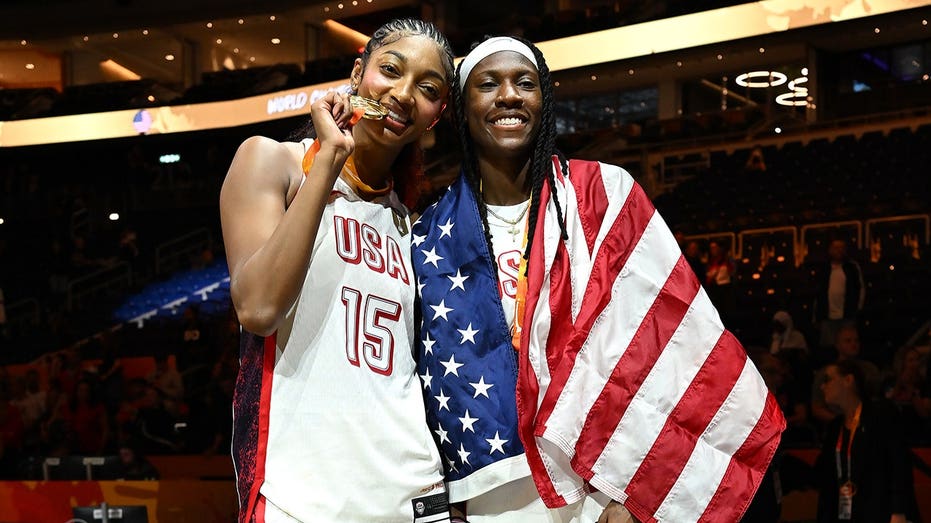
Reese and Howard were both named to Team USA’s 2026 Women’s World Cup roster. The Dream announced their selections in August, noting that they became the first two players in franchise history selected together for the United States at a five-on-five Women’s World Cup or Olympics.
Golden State had no players on that U.S. World Cup roster, but Valkyries head coach Natalie Nakase served as a U.S. assistant coach. Golden State star Gabby Williams represents France.
Both Reese and Howard stood for the national anthem while representing the United States at September’s FIBA Women’s World Cup.
But representing the United States internationally comes with an extra responsibility to show respect for the country at home.
And that responsibility doesn’t disappear when the USA jersey comes off and the WNBA jersey goes on. Staying off the court while the anthem plays during the WNBA Finals falls short of the standard we should expect from athletes entrusted with representing this country.
Former ESPN anchor Sage Steele also criticized the league in a social media video.
Steele accused the WNBA’s players, coaches and leadership of disrespecting the country by leaving the court for the anthem.
“So are they free to express themselves the way they want? Absolutely. But there’s a cost to it,” Steele said.
“And I just hope they realize that this constant lack of respect is going to turn fans away forever. They’re not going to come back, and it’s going to be their own fault,” Steele added.
Players are free to express themselves, but as Steele noted, that freedom can come with a price. We’re not calling for the players to be jailed.
The First Amendment limits the government’s power to restrict speech, but it doesn’t require fans to support those choices or critics to stay quiet. We have the right to express our disapproval, too.
Both Finals teams were off the floor during the anthem before Saturday’s opener and Monday’s Game 2 at Chase Center. In both games, the players returned within seconds of the performance ending.
The WNBA’s 2026 official rulebook includes a provision calling for players, coaches and trainers to stand and line up in a dignified posture along the sidelines or foul line during the national anthem.
OutKick contacted the WNBA and both teams after Game 1, followed up Sunday and again Tuesday. The inquiries sought explanations for the absences, clarification of the league’s anthem requirements and the teams’ plans for Game 3 on Wednesday night in Atlanta.
Those questions remain unanswered.
For Gaines, the responsibility goes beyond a WNBA pregame routine.
“Wearing the USA jersey is not a private entitlement that comes with athletic success. It is a public responsibility,” she said.


