


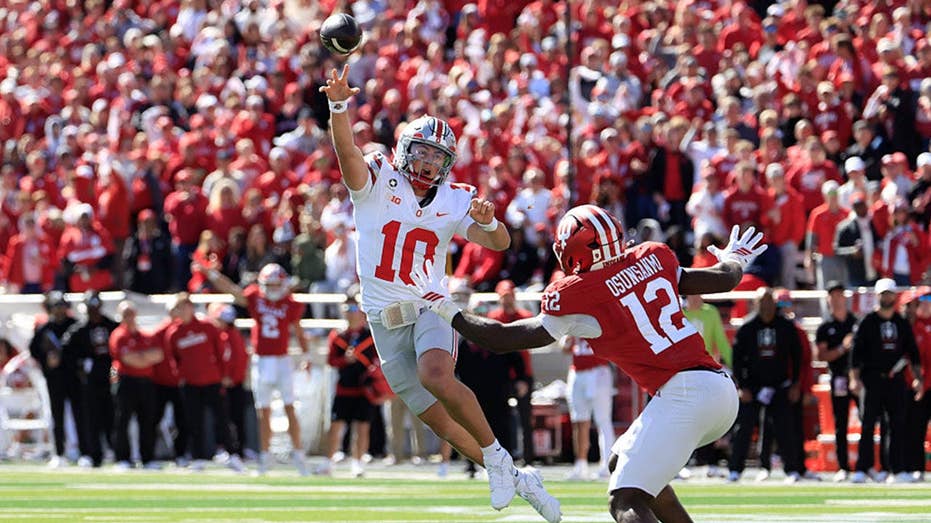
Week seven of the college football season was everything fans love about the sport. Chaos. Rivalries, like Tennessee-Alabama and Auburn-Georgia. Upsets, with BYU taking down Notre Dame in front of an exuberant home crowd in Provo. And debate over what it all means for the rest of the year.
Not one team ranked in the AP Top 25 poll in week six stayed in the same position in the week seven poll. Texas dropped 12 spots. Florida gained 12. Multiple other schools moved up or down at least six positions, with Missouri falling a whopping nine places after their blowout loss to Ole Miss.
But no stat better exemplifies the chaos of week seven better than this one. Tom Fornelli from CBS Sports posted on X this week that, “The SEC is the first conference this century to have 5 AP Top-20 teams lose in the same week.”
We’re just a few months away from completing our 26th year in this century, somehow, and the SEC was the first conference in that time frame to have five teams rankedin the top-20 lose in just one weekend. That’s pretty remarkable. And it’s also a sign of things to come.
We’ve known for some time that the advent of NIL and the transfer portal would change college football. But it doesn’t seem like we’ve come fully to grips with just how quickly that change would happen and how much of an impact it would have on the sport.
The reasons for this, and the results from it, are obvious. In decades past, a say, four-star recruit might choose to commit to Nick Saban’s Alabama, or Pete Carroll’s USC, hoping to play for championships and reach the NFL. Then find themselves losing out on a starting role to an even more highly regarded five-star player. With little recourse, short of transferring to sit out an entire season, that player likely would stay put, wait their turn, and hope they get their chance on the field.
Now though, many of those players don’t pick Georgia, Alabama, or USC in the first place. NIL has allowed smaller programs to compete for recruits they’d previously have missed out on. They might not offer the same coaching or championship aspirations, but they can offer something more immediately valuable: money.
It’s the same with the transfer portal. Lose out on a starting job? Hit the portal, go start elsewhere. Suddenly that four-star backup for Alabama is now a starter at Auburn or Tennessee. Again, it’s obvious, but this weekend’s chaos shows the result of this new era in practice: the gaps between teams are smaller than they’ve ever been.
And we have the data to prove it.
ESPN’s SP+ ranking system is an efficiency-driven rating that measures success on offense, defense, and special teams, adjusted for tempo and opposition. Essentially, trying to use the most sustainable and predictive parts of a team’s resume to remove some of the randomness inherent in sports. These ratings generally track very closely to those used by sports books to set their lines. And sports books are the best in the business at ranking the best teams, because their livelihood depends on it.
CLICK HERE FOR MORE OUTKICK SPORTS COVERAGE
Thus far in 2026, just a little over halfway through the season, there’s a clear pattern: there’s not nearly as much of a gap separating the top handful of teams from the back end of the top 25. And it’s why we’re seeing so many more upsets, with more likely coming the rest of the year.
Ohio State is currently the number one team in the rating at 26.8, roughly corresponding to 27 points better than the median college football team, around the 70th best in the country, for example. Georgia is right behind at 26.5, then Miami at 25.3, Notre Dame at 24.8, and Indiana at 23.6.
That’s already very tightly bunched, but expanding it shows how close the margins are in college football this year. Utah, the No. 10 team in SP+, is rated at 19.4, just a touchdown behind OSU. Ole Miss, at No. 14, is 17.1, meaning they’re less than a touchdown worse than Indiana. You can look all the way down to Kansas State at No. 25 and they’re essentially one score worse than No. 9 BYU.
THE CRAIG CARTON SHOW–UNFILTERED, UNAPOLOGETIC AND UNMISSABLE. DOWNLOAD HIS DAILY PODCAST NOW!
So how does this compare to the pre-portal era?
Well, looking back at 2022, it’s apparent how much, and how quickly, things have changed. The 2022 Georgia Bulldogs, in the post-bowl results, had a 37.3 rating. They were over 37 points better than the median team, compared to Ohio State’s 26.8 points in 2026.
Georgia’s 37 rating was a whopping 23 points better than the No. 25 team in that year’s rankings, Arkansas. Halfway through the 2026 season, the gap between No. 1 and No. 25 is just 13 points. Georgia was 18 points better than the No. 10 team, funnily enough also Utah, in 2022. Right now, the gap between OSU and Utah is seven points.
SIGN UP FOR THE DAILY OUTKICK NEWSLETTER
Those are gigantic differences, and it’s why the era of runaway dominance and multi-year dynasties seems to be at an end. Indiana’s 2025 season was remarkable; running through an entire year undefeated in the portal, superconference, expanded playoff era is an incredible achievement. Even Texas head coach Steve Sarkisian said prior to the season that he believed those days were over in college football. Then Indiana went 16-0.
But already, in just week seven, there is only one undefeated team remaining in the Big Ten and SEC, combined. And it’s UCLA. Just as everyone expected.
Alabama has two losses. Georgia lost at home. Texas has two losses and is lucky not to have a third. Indiana’s winning streak was snapped. Oregon has two losses and remains unranked. LSU spent about $150 million to hire Lane Kiffin and revamp their roster, and lost twice in the first six games.
The gaps between teams is small, and shrinking. Which is why there are more upsets and surprises than even the typically chaotic college football season usually provides. Oh, and Ohio State just lost their starting quarterback for “several weeks,” ahead of games against USC and Oregon. And in a perfect example of how this new era works, instead of another experienced, highly-ranked recruit backing Julian Sayin up, they’re turning to a three-star true freshman to replace him.
That hypothetical backup? He’s probably starting somewhere else.


